House Race Hinges on 46 Districts and New Maps in Seven States
With Republicans holding a 218 to 214 lead, the House majority rests on a three-seat margin and the outcome of competitive races in redistricted districts.
By Yuna Patel ·
All 435 seats in the U.S. House of Representatives are up for election on Tuesday, November 3, 2026. The current balance of power is tight, with Republicans holding 218 seats and Democrats holding 214, plus one independent. This configuration leaves Republicans with a three-seat majority. To flip the chamber, Democrats need a net gain of three districts. Republicans can afford to lose no more than two seats to maintain their control. The margin is so thin that a shift of just a handful of voters across the battlegrounds could determine which party writes the legislative agenda for the final two years of the current presidential term.
Ballotpedia has identified 46 battleground districts that are likely to determine the final outcome. Of these, 25 are currently held by Democrats and 21 by Republicans. The competitiveness of these districts is heightened by the redistricting process that took place in the mid-decade. Seven states are using new congressional maps for this election: California, Florida, Missouri, North Carolina, Tennessee, Texas, and Ohio. These new boundaries have redrawn district lines, creating new competitive environments where historical voting patterns may not hold firm. Voters in these areas are casting ballots in districts that may have different demographic compositions or geographic boundaries than they did in previous cycles.
The stakes are further complicated by the number of incumbents who have chosen not to run for re-election. According to Ballotpedia, 60 House incumbents are not seeking another term, including 23 Democrats and 37 Republicans. These open seats provide opportunities for both parties to claim ground that might otherwise be difficult to capture. The absence of well-known names in these races often leads to higher advertising spending and more intense local campaigning. Candidates are working to define their districts and establish their names with voters who may not have a strong partisan preference for a specific incumbent.
Historical voting patterns in these districts offer additional context for the race. Ballotpedia notes that 21 districts currently held by Democrats voted for President Donald Trump in the 2024 presidential election. Conversely, nine districts currently held by Republicans voted for former Vice President Kamala Harris. This divergence between presidential and congressional voting habits suggests that partisan loyalty is not absolute in these areas. Voters in these districts may be inclined to vote differently for Congress than they did for the presidency two years ago, making the outcome of these specific races uncertain and highly sensitive to local issues and candidate performance.
The Associated Press describes the election as a referendum on President Trump's second term, with many voters expressing concern over high prices and the direction of the country. In an AP-NORC poll, 35 percent of U.S. adults approved of the president's job performance, while 25 percent approved of his handling of the economy. About 7 in 10 respondents said the country is heading in the wrong direction. These national sentiments are likely to influence how voters in the 46 battleground districts cast their ballots. Economic anxiety is a central theme, with many voters citing the cost of living as a primary driver for their choice in the House race.
Turnout remains a critical factor in these close races. Republican National Committee Chairman Joe Gruters stated that everything depends on turnout, asserting that if they turn out their voters, they win. The Democratic Congressional Campaign Committee Chair, Rep. Suzan DelBene, countered that the American people are angry and want change. Both parties are mobilizing their bases in the 46 battleground districts, recognizing that the three-seat margin leaves little room for error. Early voting numbers have already surpassed those of four years ago in many states, indicating a high level of engagement that could sustain high turnout through Election Day.
The new maps in the seven redistricted states add a layer of complexity to the analysis. In states like Florida and Texas, the new districts may not vote as they were drawn, challenging the strategic assumptions of both parties. Republicans had hoped to use redistricting to secure a larger majority, but the competitive nature of the 46 battleground districts suggests that the gains may not be as decisive as anticipated. Democrats are focusing their resources on the 25 Democratic-held districts that are considered vulnerable, while Republicans are defending the 21 Republican-held districts that are in play. The interplay between these two sets of districts will determine the final count.
Voters in these districts are also weighing the broader implications of the House race. If Democrats win control, investigations and oversight of the executive branch are likely to increase. House Democratic Leader Hakeem Jeffries has outlined a 100-day agenda focused on the cost of living and oversight if his party takes the majority. Republicans are working to counter the traditional midterm pattern where the president's party loses seats. The outcome in the House will shape the legislative landscape for the next two years, affecting everything from budget priorities to committee leadership.
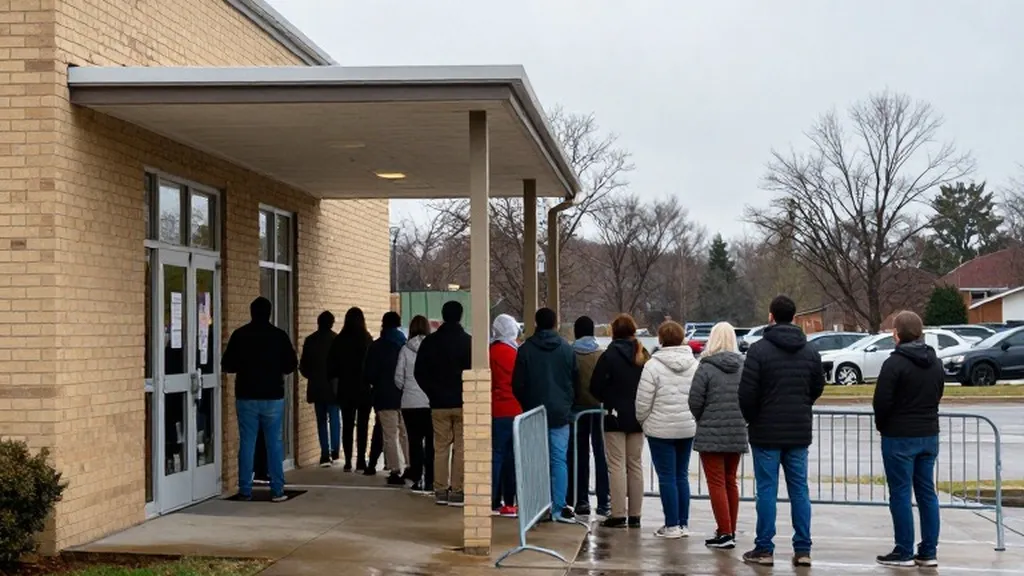
As polls open across the country, the focus is on the 46 battleground districts that will decide the House majority. The three-seat margin means that every vote in these areas carries significant weight. Voters are heading to the polls in a tight race where the new maps and the absence of many incumbents have created an uncertain environment. The final result will depend on how voters in these specific districts respond to the national mood and the local campaigns that have defined the election.
The U.S. Postal Service has added hours, staff, and special lines to ensure that mail ballots are counted on time, a logistical detail that could impact the final tally in some of the battleground states. Wall Street is also watching the results, with Reuters noting that control of Congress could influence investor concerns about spending and debt ceiling negotiations. The House race is not just a partisan battle but a critical decision for the stability and direction of the federal government in the final two years of the current term.