Arizona Grapples With Data Center Water Demand
Residents in Phoenix and Tucson are organizing against large data center proposals as the state prepares to lose nearly 30 percent of its Colorado River water.
By Yuna Patel ·
Arizona is confronting a wave of opposition to new data center construction as the state prepares to lose nearly 30 percent of the water it receives from the Colorado River. Residents in Phoenix and Tucson have formed coalitions to challenge proposed facilities, marking a shift from the reception given to earlier projects.
The Taiwan Semiconductor Manufacturing Company, which controls an estimated 70 percent of the global chip market, operates an advanced semiconductor foundry in north Phoenix. The facility draws nearly 5 million gallons of water daily from Phoenix's municipal supply. TSMC has brought more than 3,500 jobs to the state, and its projected expenditure in Arizona has risen from an initial $12 billion estimate to $265 billion, a figure the company describes as the largest foreign direct investment in US history.
Christine Mackay, who heads Phoenix's economic development office, led the effort to recruit TSMC to the region. The company began searching for a US location in 2016. Phoenix sent a delegation to Taiwan in 2019 to present a science and technology park development plan, and TSMC executives toured sites in Laveen and Biscuit Flats, an undeveloped area north of Phoenix.
TSMC's second fabrication facility has been completed, with a third under construction. The company's contracts with Apple and Nvidia account for more than one-third of its annual revenue. Apple and Nvidia design their own chips but outsource the manufacturing process.
Proposed hyperscale facilities differ in scale from earlier projects. Some hyperscale data centers, such as Google's facility in The Dalles, Oregon, use about 1.5 million gallons of water per day, roughly one-third of what TSMC's Arizona complex consumes. Developers have offered jobs, tax revenue, and infrastructure improvements in exchange for water access.
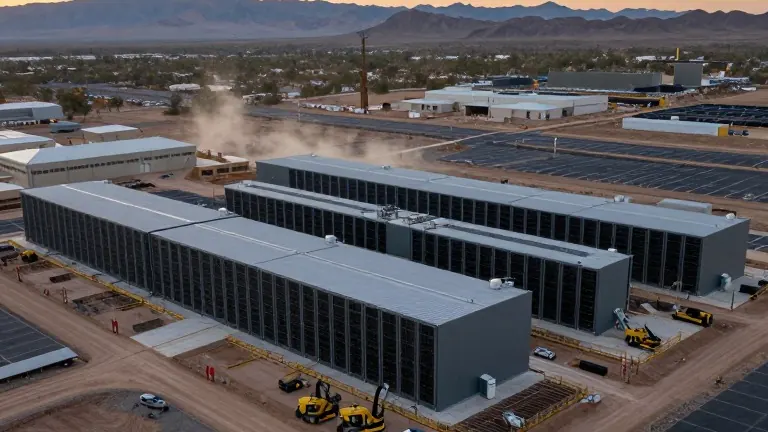
Opposition has centered on a 290-acre site outside Tucson where Beale Infrastructure is building a 600-megawatt facility known as Project Blue. The No Desert Data Center Coalition held a rally at the site on August 1st. Organizer Vivek Bharathan told attendees that data centers can raise surrounding temperatures by over 10 degrees Fahrenheit.
Mayra Duron, a macrame artist who uses cactus spines in her weaving, said she worried about rising heat and its effect on saguaros. "In Phoenix, it's hyper-industrialized," she said, "and they've seen saguaros die left and right." Mackay, who has worked in economic development for more than 30 years, said the first 10 data centers she handled resembled small office buildings.
Arizona's economy historically relied on five industries: cattle, copper, cotton, citrus, and climate. Mackay said the state now has a sixth: "Chips." The TSMC foundry operates without significant opposition while new data center proposals face organized resistance at city council meetings across the state.
Source: The Verge