Syrian Protests Erupt After Israeli Strike Kills Disabled Man in South
Mass demonstrations in Damascus and Homs follow a fatal incursion, signaling strong domestic opposition to Israel's expanded security zone in Quneitra and Daraa.
By John Wilson ·
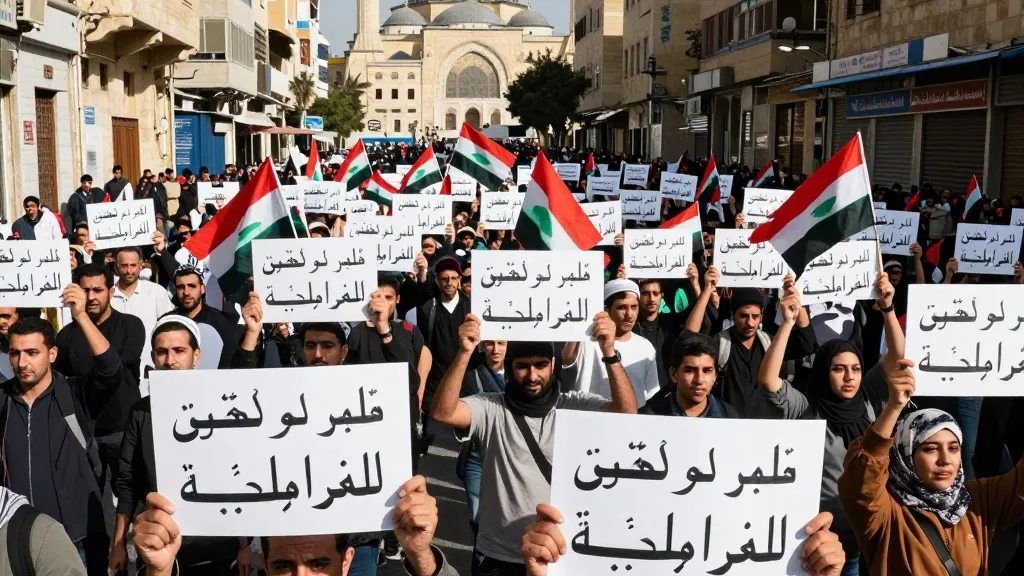
Syrian citizens took to the streets across the country on Friday to protest repeated military incursions by Israel into the southern provinces, a move that has intensified tensions following the death of a man with a disability earlier in the week. The rallies represent a significant mobilization of public support for the new government, which has sought to assert sovereignty over territories where Israeli forces have maintained a persistent presence.
The timeline of these events began with the establishment of a new political order in Damascus after the ousting of Bashar al-Assad in December 2024. Since that transition, the Israeli military has executed hundreds of airstrikes and conducted frequent ground operations within Syrian borders. A major shift occurred when Israeli troops moved into the United Nations-patrolled buffer zone on the Golan Heights, an area that had served as a separation line since 1974. This expansion was followed by the specific incident in Daraa province, where a man with special needs was killed by Israeli fire during an incursion.
State media reports indicate that large crowds gathered in the capital, Damascus, and in the central city of Homs to denounce the actions in the southern provinces of Quneitra and Daraa. In Daraa, an AFP correspondent observed hundreds of participants at a rally, many of whom waved national flags. The demonstrations were characterized by a unified message of national resilience in the face of external military pressure.
Visual evidence from state television showed marchers holding posters with the slogan 'We are all Moaz.' This phrase references the disabled man who was killed in the recent incursion, turning his death into a central symbol for the protest movement. The rallying cry served to consolidate public sentiment around the need for a clear response to the military activities in the south.
In Damascus, the protests also highlighted specific cases of detention. Outside a United Nations building, the family of a Syrian man seized by Israeli forces demanded his release. Children in the crowd held signs reading 'I want my dad,' adding a personal dimension to the broader geopolitical dispute. These individual stories helped frame the incursions as a direct impact on daily life and family stability.
On the ground, state media reported that Israeli forces advanced into parts of Quneitra province on Friday. They blocked several major roads, bulldozed olive groves, and established new checkpoints while detaining local residents. These physical alterations to the landscape underscore the scale of the military footprint in the region.
Looking ahead, Israel has vowed to maintain troops in a designated security zone in southern Syria. The military seeks to establish a broader demilitarized area, a strategy that continues to drive the friction between the two nations. As the new Syrian government consolidates power, it faces the challenge of balancing this domestic pressure for sovereignty against the strategic realities of its southern border.
Source: Middle East Eye