Sorbonne Scientists Reproduce Mars Cloud Using Unseen Ice Physics
A new model explains how a 1,000-mile cloud forms near Arsia Mons by relying on a process that requires humidity levels 100,000 times higher than on Earth.
By Yuna Patel ·
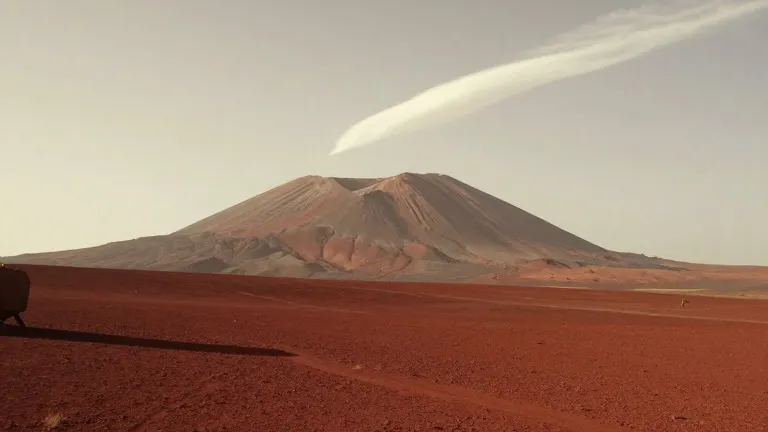
Planetary scientist Jorge Hernández-Bernal and colleagues at Sorbonne Université in Paris have developed a computer model that successfully recreates a mysterious cloud on Mars. The feature, known as the Arsia Mons Elongated Cloud, forms near the planet's Arsia Mons volcano. It stretches across more than 1,000 miles during the Martian spring and summer before dissipating. The model identifies a specific physical mechanism responsible for the cloud's creation.
The simulation reveals that the cloud forms through homogeneous nucleation. In this process, water vapor turns directly into ice crystals without needing dust or salt particles to act as a seed. On Earth, clouds typically form when vapor condenses around such debris. Hernández-Bernal described the Martian process as unexpected, comparing it to condensation appearing in the middle of a room rather than on a window. He noted that while this physics appears in textbooks, it is usually treated as theoretical rather than a natural occurrence.
The conditions required for this process are extreme. The model shows that the air must cool by 30 degrees Celsius within 10 minutes. Additionally, the relative humidity must be exceptionally high. When wind hits the 65,000-foot Arsia Mons, it generates a powerful wave. This wave lifts moist air high into the atmosphere in minutes, creating the necessary environment for the rare ice formation.
The humidity levels required for the cloud to form are more than 100,000 times greater than any value measured on Earth. Scientists had long assumed similar nucleation could occur in the upper atmospheres of planets like Venus and Earth, but it has never been directly observed. The extreme humidity likely explains why the process remains invisible in our own sky. Researchers did not previously know that such high humidity existed on Mars.
A probe first recorded the cloud in 2018. Since then, scientists have struggled to explain how a feature of that size could form and vanish so predictably. The new study, published in Nature Geoscience, is the first to reproduce the cloud's formation in a model. Hernández-Bernal stated that the result is remarkable, given that far less is known about the Martian atmosphere than Earth's. The work confirms that the cloud's existence relies on physics that has not been directly seen in any planetary atmosphere before.
The cloud's cycle repeats over several months during the Martian spring and summer. It grows gradually longer through the morning until it reaches a length comparable to the straight-line distance from New York to Kansas City. The new model provides a concrete explanation for this daily phenomenon. It demonstrates that the interaction between wind, volcanic topography, and extreme humidity drives the formation of one of Mars' most distinct atmospheric features.
Source: Wired