McCollum Captures Three Halley Meteors in Georgia
The Toccoa photographer recorded the debris trails on Oct. 21 using a Canon EOS Ra camera and star tracker.
By Yuna Patel ·
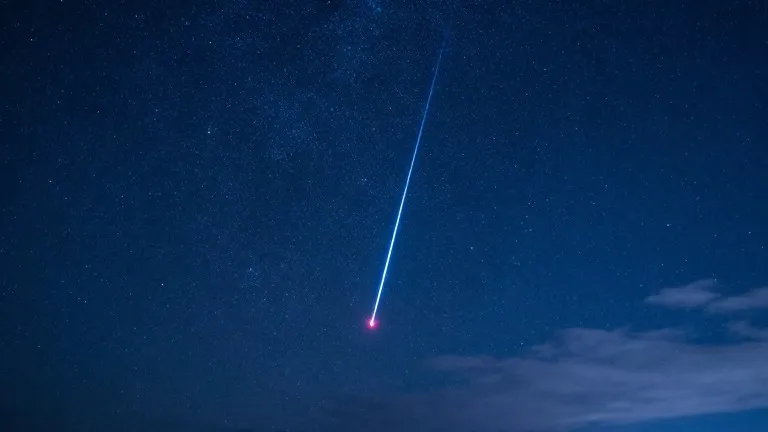
Tim McCollum photographed three meteors from Halley's Comet over Toccoa, Georgia, on Oct. 21. The image captures the debris streams during the annual Orionid meteor shower. McCollum recorded the activity between 3 a.m. and 4 a.m. local time.
The meteors originate from Comet 1P/Halley. This comet is currently more than 3 billion miles from Earth. The particles it left behind still create glowing trails in the autumn sky. Each meteor in McCollum's image appears to race away from the shower's radiant point.
That radiant point lies near Betelgeuse. Betelgeuse is a red giant star located in the constellation Orion. McCollum used a Canon EOS Ra camera paired with an RF 28-70 f2.0 lens. He shot multiple 30-second exposures to capture the fleeting light.
A star tracker kept the camera locked on the radiant throughout the session. McCollum merged the individual frames into one composite image. He used PixInsight astrophotography software to combine the shots. The resulting frame shows the meteors against a dense starfield.
The image includes the stars of Orion's Belt. These stars sit on the right side of the photo. They appear near the glow of the Orion Nebula. The Rosette Nebula is also visible within the Milky Way's galactic plane. This nebula is catalogued as Caldwell 49.
The Orionids remain active until Nov. 7. This gives skywatchers more time to spot the debris. Earth is also passing through debris streams from Comet 2P/Encke. This produces the Taurid meteor shower and occasional Halloween Fireballs.
Space.com accepts astrophotography submissions from readers. Photographers can send their images, comments, name, and location to spacephotos@space.com. The annual display continues to build toward its peak activity in the coming days.
Source: Space.com