Disability Turnout Lags Despite New Voting Options in Missouri
Data shows a persistent gap in participation for voters with disabilities, prompting advocates to push for clearer signage and better access to curbside ballots before the general election.
By Yuna Patel ·
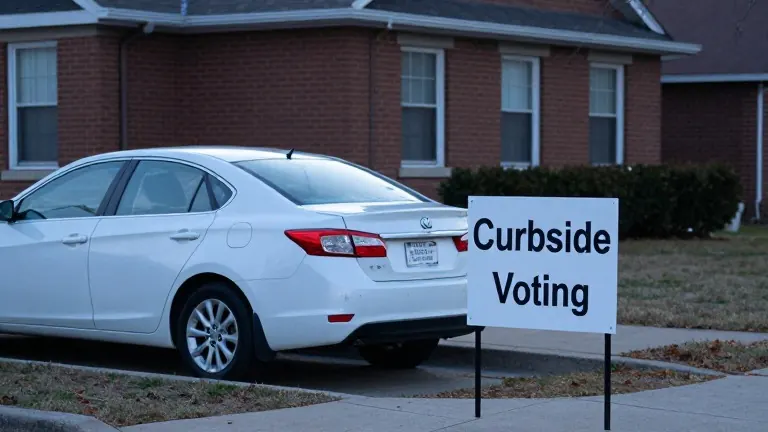
Turnout for voters with disabilities was 1.5 percent lower than the national average in 2022, a gap that disability rights advocates say persists despite legal protections and recent procedural changes. As the general election approaches, local leaders in St. Louis are focusing on ensuring these voters understand their available options, particularly curbside voting.
Teona McGhaw, a 49-year-old above-the-knee amputee, has spent her career addressing these barriers. Born with a rare birth defect that required the amputation of part of her left leg, McGhaw received her first prosthetic limb at age three. She now serves as the East Region vice president of membership for the National Women’s Political Caucus and co-founded the community support nonprofit the Mission Attempt. McGhaw was the first Black woman elected as president of the Missouri Women’s Political Caucus in 2022 and is considering a run for a statewide seat in 2028.
McGhaw argues that a lack of visibility for voting options creates unnecessary hurdles. She notes that while Missouri is one of nearly half the states with curbside voting laws, implementation is inconsistent. According to the Movement Advancement Project, approximately 23 states, including New York and Tennessee, lack specific laws for curbside voting for people with disabilities.
Data from the U.S. Election Assistance Commission and Rutgers University indicates that voter participation for people with disabilities generally trails other groups. In 2018, the turnout gap was 4.8 percent. The Missouri Foundation for Health reported that one in seven Missouri voters with disabilities experienced difficulties voting in 2022. Additionally, 36 percent of registered voters in the state reported not voting due to a disability or illness, either their own or a loved one’s, that year.
McGhaw points to funding as a central issue. She stated that money is not being poured into accessibility, which remains a barrier for many. She emphasized that while absentee voting is promoted, some voters prefer in-person participation because they are uncertain about the receipt of mail-in ballots. She said, “I want to be a voice for people that are like me. I have a lot of experience, a lot of failures. But I don't want people to have to wait as long as I did to put things into perspective. As a person with a disability, you matter. It's 2026, and some people still don't know what curbside voting is.”
In Missouri, every polling site is responsible for making curbside voting available. McGhaw said she has pushed for years for libraries and other locations in north St. Louis County to post signs indicating this service. She observed recent shifts toward better compliance. “I ride around and I look, I check,” she said. “I think it should be a duty of the people working the polls to make sure that people with disabilities are made aware of their options. That would make people feel like they matter.”
Beyond curbside voting, voters with vision impairments can request in-person assistance with reading and filling out ballots. Those who cannot leave their homes or face elevated health risks can use mail-in ballots. This option was expanded by Missouri legislators in 2022 through No Excuse Absentee voting. The pandemic also drove states like Missouri and Illinois to expand early and curbside voting, contributing to a record number of pre-election votes in 2020.
McGhaw noted that the 2020 cycle demonstrated the practicality of curbside voting, with early votes accounting for the majority of nearly 160 million votes cast nationwide. She argued that this method should not be limited to voters with disabilities. She cited her experience raising three boys, noting that mothers often prefer to vote from their vehicles to avoid getting children out of the car. She said, “That was a very good example of how easy curbside voting worked. Everybody was in their car just voting then, and it was working.”
Additional resources include voter badges through vot-er.org/badge for access to hospitals and clinics. Homebound voters can apply for an ID to be mailed through Missouri Access ID. Residents of nursing homes can review their rights through the Missouri Department of Health and Senior Services.
Source: KWMU