Carrion Crows Solve Visual Puzzles at Double the Speed of Primates
A University of Tübingen study shows that birds reach complex decisions in half the time required by monkeys, despite lacking a neocortex.
By John Wilson ·
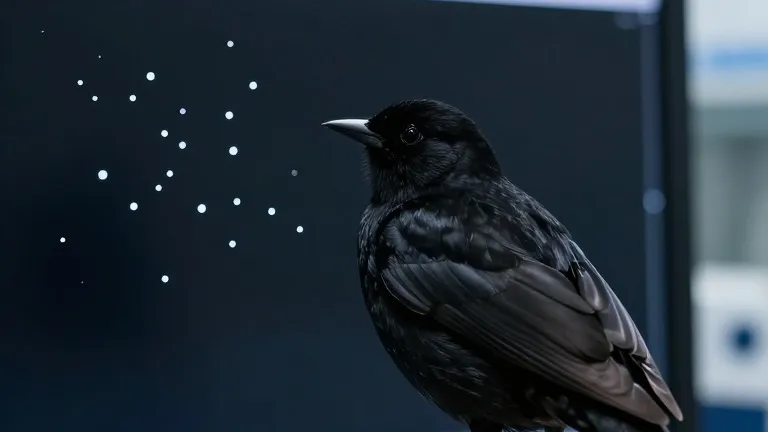
Carrion crows reach visual decisions at twice the speed of primates, according to a new study from the University of Tübingen.
The research team applied the random-dot-motion task, a standard test for cognitive processing, to two hand-raised birds. In this experiment, a cloud of flickering specks drifts weakly in one direction. The subject must identify the direction of movement. In primates, neurons in the neocortex accumulate visual evidence over time. Their firing rates rise until they cross a specific threshold, triggering a committed choice. Birds lack this brain structure, leaving their decision-making process unclear.
Andreas Nieder, a neurobiologist at the University of Tübingen, noted that this gap in knowledge presented a major challenge. "This was the big question," Nieder said. "How [would] a differently organized avian brain encode decisions?" To address this, Nieder and colleague Philipp Schmidbauer recorded brain activity while the crows performed the task. The birds faced a touch-sensitive monitor displaying white dots on a black background. A subset of these dots moved coherently in one of four directions. The crows indicated their perception by pecking a target adjacent to the screen. A correct answer resulted in a mealworm reward.
The researchers ensured the experimental setup mirrored the standard primate version. "We intentionally wanted to have exactly the same random-dot motion task," Nieder said. The primary mechanical difference involved the method of response. Crows used pecking, while monkeys typically use eye movements to signal their choice.
The team adjusted task difficulty by varying the percentage of dots moving coherently. The easiest condition involved 81 percent of dots moving together, a trivial signal. The hardest condition included only 3 percent coherent movement, a signal barely distinguishable from static noise. The protocol also included a zero percent condition with no correct answer.
The crows utilized the same mathematical logic as primates to solve the task. Despite the different brain architecture, the birds completed the decisions in half the time required by the monkeys. This finding suggests that a brain without a neocortex can execute comparable decision-making processes.
The study provides a new data point for understanding avian cognition and the efficiency of neural processing in species with different brain structures.
Source: Ars Technica
More Business · Tech news · Business Watchdog · Report a business · Got a Story?