Funeral Shooting in Jordan Leaves Nine Dead as Security Tightens Across the Kingdom
A rare assault on a Christian congregation in Karak governorate has resulted in significant casualties and a nationwide review of protective measures at high-profile sites.
By Yuna Patel ·
The safety of Jordan’s religious and commercial hubs has taken a significant hit following a violent incident that claimed nine lives and injured forty others on Friday. The attack, which targeted a funeral service, has prompted immediate changes in how security is managed at public gatherings and key infrastructure sites across the country.
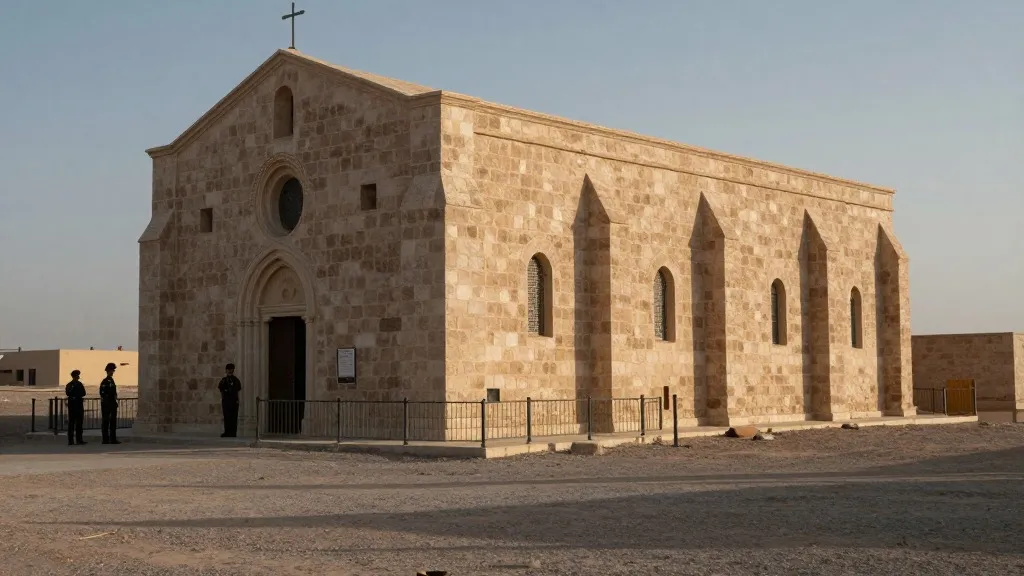
The incident occurred at St George’s Greek Orthodox church in Hamoud, located within Karak governorate. While the initial chaos made it difficult to gather precise figures, the health minister confirmed the number of injured at forty. Maj Gen Abdallah al-Maaytah, who heads the Public Security Directorate, stated that the majority of the wounded were receiving medical treatment. He noted that a search for the remaining suspects was still underway as of the latest updates.
Government officials have identified the perpetrators as extremists. Interior Minister Mazin Al Farrayeh described the event as a terrorist act but cautioned that it was premature to determine specific affiliations with known groups inside or outside Jordan. No organization has yet claimed responsibility for the shooting, leaving the exact ideological drivers of the attack under investigation.
Visual evidence from the scene provided clarity on the method of the assault. Footage from a security camera, verified by Reuters, showed three individuals firing from a pavement area. They used trees and a low wall for cover before running toward the church entrance. This sequence of events aligns with witness accounts of a sustained burst of gunfire that lasted several minutes.
Those present at the service described a scene of immediate panic. Theodoros Soueiss, a priest at the church, recalled instructing attendees to get down as the situation escalated. He described the gunfire as indiscriminate, noting that no one knew where the bullets would land. Khaled Burqan, another attendee, confirmed that dozens of people were gathered when the shooting began. Ihab Ammareen, who witnessed the aftermath, described people collapsing with visible injuries and the loud cries of those affected.
The political response was swift and emphatic. Prime Minister Jafar Hassan labeled the event a product of terrorist ideology and blind extremism. He vowed that society would not follow that path. King Abdullah, a key partner for the United States in the region, visited Karak within hours of the attack. He pledged that the perpetrators would be punished with an iron fist and stated that those attempting to divide the nation with bullets would fail in the face of national unity.
In the immediate aftermath, the U.S. embassy in Amman announced that security has been stepped up at malls, foreign embassies, and other locations throughout the kingdom. This move reflects a broader concern about stability in a region that has seen various security challenges this year. Jordan is home to several biblical sites that attract pilgrims, making the Christian minority a visible and significant part of the local landscape.
The attack has raised questions about how extremist ideologies take root. Outside a government hospital in Karak, where families gathered to support the wounded, Hani Al-Mbaydeen expressed the shock felt by many. He urged the state to investigate the source of such dark ideas and how they enter the minds of children, highlighting the personal cost of the conflict.
Source: The Guardian